In popular culture, Tokyo is often described as a futuristic city: the ubiquitous neon and plasma screens, the teeming streets and the cyclopean expanses of concrete, glass and steel often make it appear that way. Amongst the skyscrapers and neon lights of the Japanese capital, an alternative universe is hidden in which manga & anime characters come to life. An alternative universe to discover in two days. To fully immerse yourself in this wondrous city during your short stay, finding ideal accommodations enhances your experience. Hotel deals in Tokyo at tokyo-hotels-stay.com provides plenty of options to cater to your specific needs and budget, making sure your stay is both comfortable and convenient. For those who seek a little more luxury, or simply want to ensure their stay is nothing less than perfect, Book Top Rated Hotels in Tokyo at tophotels.com. With its careful curation of prime hotels in the bustling city, you're sure to find your perfect fit. If you're looking for a specific hotel recommendation, the Belmont Hotel Tokyo is a popular choice amongst travelers. Renowned for its excellent services and prime location close to numerous attractions, it provides a perfect base for your Tokyo exploration.

Japanese pop culture
This is the city that Godzilla destroyed (several times), but it is also the city that created Godzilla: Tokyo is the hub of Japan's pop culture industry. A culture that influences the whole world: surely you too are familiar with the adorable Hello Kitty, the daring Mario and Luigi from Nintendo's first games, the best-loved Pokémon of all, Pikachu, or Miyazaki Hayao's poetic animation masterpieces, such as the Oscar-winning The Enchanted City (2001).
If you adored anime and manga in your teenage years, Tokyo is probably already one of your dream destinations. But you don't have to like that kind of cultural product to enjoy yourself here. Japanese pop culture will show you the playful side of Japan, an inverted universe populated by legendary monsters and giant robots, where fantasy reigns supreme, inanimate objects come to life and everything is colourful.

Day One
Ghibli Museum, Mitaka
First stop: the museum that director Miyazaki Hayao designed to display the work of his Studio Ghibli. Miyazaki designed this museum like his beloved animated films: a source of wonder, discovery and inspiration. The interior houses a cinema showing original short films, artwork, old vintage animation tools and a thousand nooks and crannies to explore.
Miyazaki's career spans half a century (and the master seems to have no intention of stopping). Even today, much of the work at Studio Ghibli is done by hand, often in watercolour, which gives the frames their characteristic fairytale atmosphere. Studio Ghibli, after all, has made six of the ten most successful Japanese animated films. Enchanted City (2001) is perhaps the most famous, but Princess Mononoke (1997), Laputa - Castle in the Sky (1986) and Nausicaä of the Valley of the Wind (1984) are also not to be missed.
Access to the museum is allowed in small groups: book tickets in advance (they disappear quickly!), specifying the date and time of your visit, at a travel agency. After the museum take a walk through the lush Inokashira Park - perhaps stopping for lunch - to Kichijōji Station.
Nakano Broadway
When Nakano Broadway shopping centre was built in the 1960s, it was a temple of fashion. Today it is a time machine with a magnificent vintage atmosphere. It is also a favourite haunt of Tokyo's otaku (manga and anime fans). Many of the shops it houses sell film stills, action figures, models and vintage toys. Take a tour and then head to Shinjuku (a must on a perfect day out in Tokyo), a train stop away.

Godzilla statue
We'll be honest: this statue is unabashedly aimed at tourists. But never mind: who could resist the temptation to go and admire a life-sized Godzilla? The installation is part of an entertainment complex created in 2015. If you want to admire it up close, head to the café on the eighth floor of the Gracery Shinjuku Hotel, where you can order tea and sweets (and take magnificent photos) under the monster's head as it tries to devour you.
Godzilla - conceived from a Japanese mythological creature resembling a whale(kujira in Japanese) - first appeared in Japanese cinemas in 1954. The result of the nefarious effects of atomic radiation, he was played at the time by a mime wearing a heavy rubber suit. Over the decades Godzilla has appeared in some 20 films, transforming from a fearsome creature to a legendary icon. The Shinjuku district even named him a cultural ambassador in 2015.
Otome Road
Cosplay (the art of dressing up to resemble a character from an anime or manga) is one of the most endearing elements of Japanese culture. Fans take the activity very seriously, and reflect their love for the character they play by devoting maniacal care to reproducing his costume.
Otome Road is a street full of shops specialising in products for geeky girls: but because not only girls appreciate cosplay, Otome Road is also home to the best costume shops in Tokyo. Come here to admire the endless array of colourful wigs, not to mention the coloured contact lenses, false eyelashes (and even tears!).

Maricar
The Maricar is a dream come true (or rather, it makes dreams you didn't even know you had come true): touring Tokyo in a go-kart while dressed as Mario from Super Mario Kart, or as a superhero or Winnie the Pooh, the choice is yours.
We recommend a night tour to the Shibuya Crossing, lit up by dozens of neon lights: the crowds that usually throng this huge intersection will celebrate your arrival with enthusiasm, and you'll probably end up in some other traveller's photo.
Day Two
Sanrio Puroland
Day two opens at Sanrio Puroland, Tama, a thirty-minute train ride from central Tokyo. Hello Kitty's impassive expression may be dull, but her amusement park is the exact opposite. At Sanrio you can check out Kitty's house, take a boat ride through her enchanted world and get to know her friends, the other characters that make up the Sanrio pantheon.
The most popular now is Gudetama, an anthropomorphised egg with a dark expression. Admission times vary: check before you go.
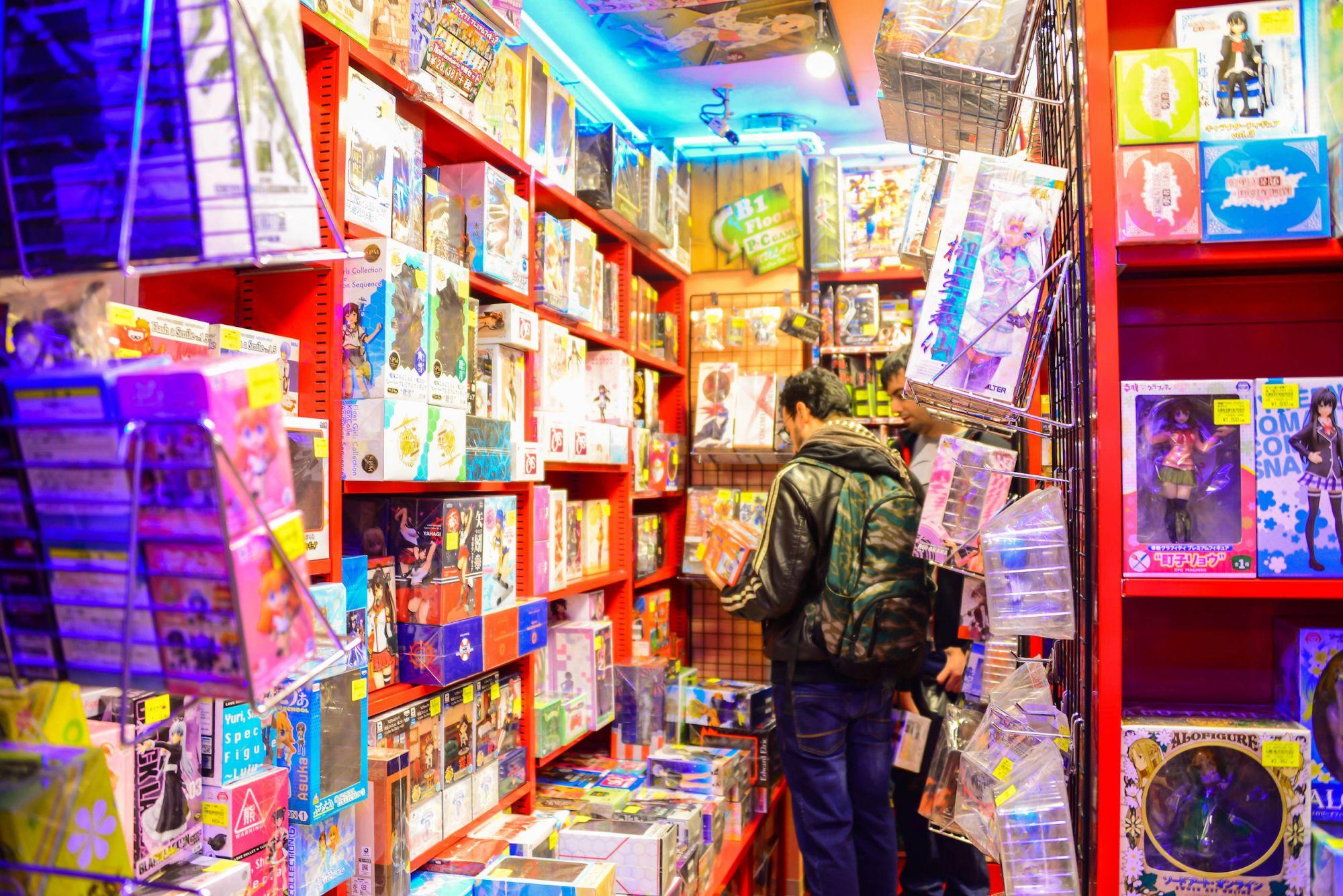
Akihabara: the manga district
A tour of Tokyo's pop culture would not be complete without a trip to the Akihabara district - the sun in a solar system of anime and manga. Among the dozens of shops, you can't miss a retro arcade, Super Potato Retro-kan, full of arcade games dating back to the 1980s such as Pac-Man and Street Fighter. On the way back, take the train to Shimbashi and change to the line for Yurikamome, an underground surface train that snakes between skyscrapers to the man-made island of Odaiba.
Jicoo floating bar
Leiji Matsumoto is the creator of the anime The Battleship Yamato, a futuristic television series that paved the way in the 1970s and 1980s for the advent of sci-fi anime; he is also the designer of the battleship (space one, of course) that headlines the series and looks like something out of... a cartoon.
By day it is one of the Tokyo Cruise boats, but three nights a week it floats quietly in Tokyo Bay with live music and DJs, and a spectacular view of the city skyline.
Let's avoid ugly figures
Language, it is known, is one of the great drawbacks of a trip to Japan. Japanese is far from easy to approach and the inhabitants of the Rising Sun do not speak English with much pleasure. How to avoid possible bad impressions? Simple: just know the (at least basic) useful phrases for a trip to Japan. After using kon-ni-ci-ua ('hello') and go-zai-mas ('good morning') sensibly, you will see that conversations will take a good turn.
Tour of classic Japan
Manga and anime will be a key part of the trip but not the only one. If this is your first time in the Rising Sun, we recommend a tour of classical Japan: Tokyo, Kyoto and Hiroshima will be the three stops on a journey full of fascination and tradition.